
The First Rite
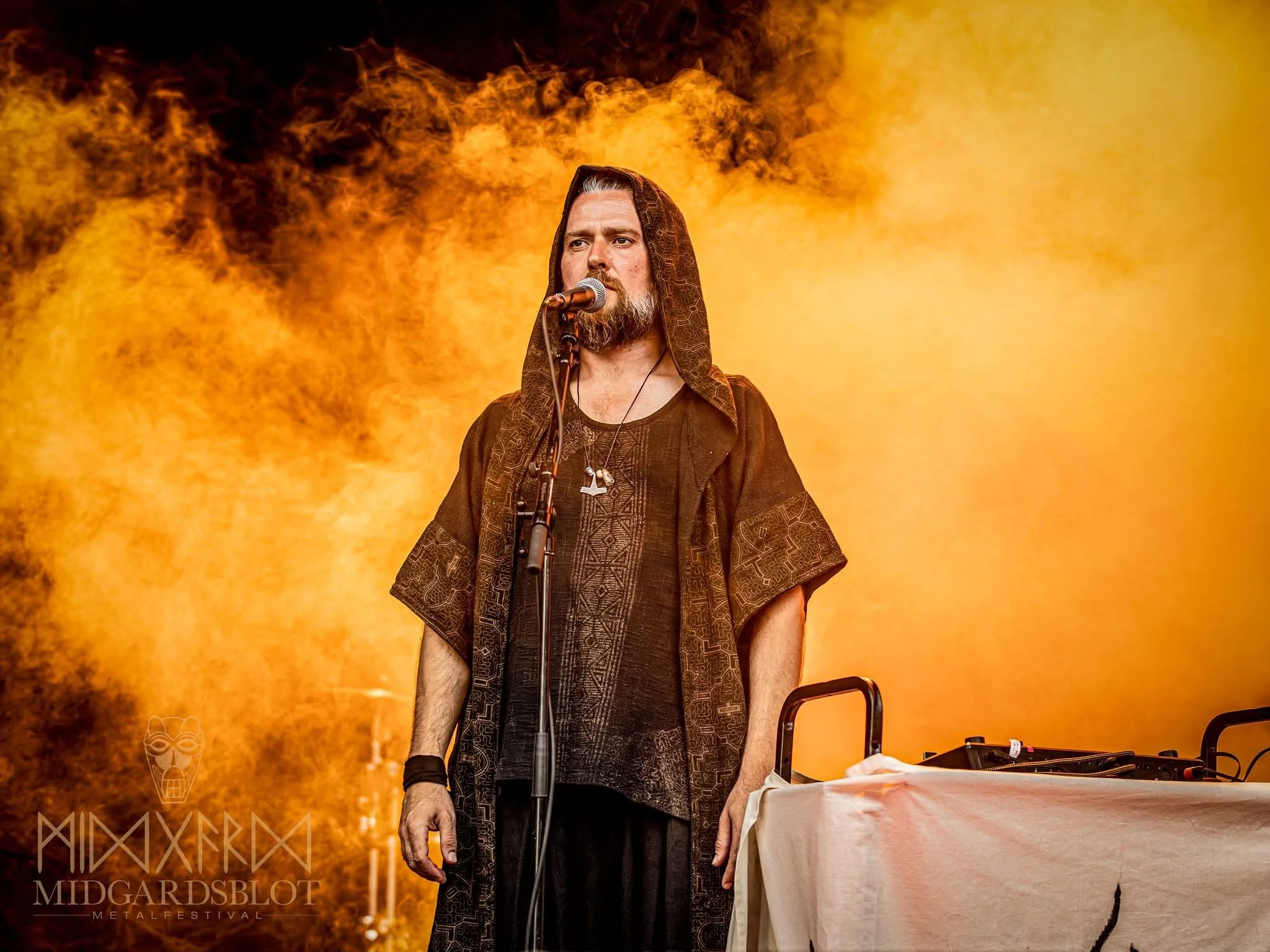
Nebala at Midgårdsblot 2026
There are moments when something you have carried alone for a long time suddenly no longer belongs only to you.
For me, that moment happened at Midgardsblot.
For years, Rites of Passage had existed as an idea, a collection of sounds, stories and questions about the passages we all move through as human beings. Birth. Childhood. Coming of age. Union. Loss. Death.
We had spent months preparing to bring that journey onto a stage. Musicians, performers, costumes, movement, scenography and ritual had slowly been woven together around the music.
But until that evening in Borre, we had never performed it for anyone.
And then, about an hour before we were supposed to walk on stage, the sky broke open.
Before the rite
The weather at Midgardsblot had been beautiful. Then, while we were preparing the stage and getting into our clothes, an enormous crack of thunder suddenly rolled across the festival.
Almost immediately someone shouted:
“EVERYONE OFF THE STAGE. NOW.”
The festival grounds were closed because of the approaching thunderstorm. Nobody was allowed to remain on stage.
So there we were.
Our first Nebala concert. The world premiere of an album that had not even been released yet. Months of preparation behind us.
And we were sitting in a tent beside the main stage, waiting to hear whether any of it was going to happen.
There was nothing left to prepare. Nothing left to control.
We could only wait.
Looking back, there was something strangely fitting about it. We were about to perform a work about transition — about entering the unknown and allowing yourself to be changed by it — and suddenly we found ourselves suspended in exactly that place.
Eventually, the storm passed.
The festival reopened.
And we were told we could play.
Rites of Passage
When we walked onto that stage, none of us knew what would happen.
The audience had never heard this music. They didn't know the story. They didn't know where we were going to take them. But they came with us.
Rites of Passage moves through the human life cycle — from the beginning of life, through childhood and transformation, into adulthood, union, ageing and finally death.
On stage, the music was joined by bodies, movement and imagery. The musicians and performers weren't there simply to illustrate the songs. Together we were trying to create a space in which the story could be experienced rather than explained.
And somewhere during that hour, something shifted.
The boundary between stage and audience began to feel less clear.
People weren't simply watching anymore.
They were participating.
One person later described it in a way that has stayed with me:
“They prepared the ritual but we all made it happen together.”
That is perhaps the closest anyone has come to describing what I had hoped Nebala could become live.
What happened in the audience
From the stage, you can only understand fragments of what is happening in front of you.
I could see faces. Movement. People holding one another. I could see tears.
But it wasn't until afterwards that I began to understand how deeply some people had experienced it.
Messages started arriving.
“We danced, we hugged, we cried. I don't think I've ever seen an audience so invested with so many tears at the end.”
Someone else wrote:
“It felt amazing to release a bunch of emotions that I didn't even realize I was holding on to.”
And another:
“We all felt it in our hearts, we all cried, and then we hugged it out as we stood in awe.”
Again and again, people wrote about the same things.
Not just the music.
Release. Grief. Connection. Tears. Being held by strangers. Moving through something together.
One person told me that Rites of Passage had brought “grown men and ladies all teared up in the end.”
Another simply wrote:
“That show may have been the best I've ever seen.”
Reading those messages afterwards was overwhelming.
Because Rites of Passage was never intended to be a spectacle observed from a safe distance.
The hope was always to create something people could enter.
We all made it happen together
One of the messages we received spoke about trusting “the community and its healing powers.”
I keep returning to those words.
Modern life gives us very few places in which we are allowed to move collectively through the things that fundamentally change us.
We still experience birth. We become adults. We love. We lose. We age. We die.
But many of the rituals that once helped human beings acknowledge those passages have disappeared or become disconnected from the communities around us.
Rites of Passage grew from my fascination with that absence.
I don't believe a concert can simply recreate what has been lost. Nor do I want Nebala to imitate rituals belonging to another people, culture or time.
But perhaps music can still create a temporary space in which we remember something very old and very human:
That we don't necessarily have to move through everything alone.
For one hour at Midgårdsblot, that is what it felt like.
We had built the structure.
But the people standing in front of us completed it.
They cried together. They moved together. They held each other.
We prepared the ritual. But we all made it happen together.
The beginning
Midgardsblot was Nebala's first concert performing Rites of Passage.
There will be other stages. Other audiences. And Rites of Passage will soon leave our hands completely when the album is released into the world.
But there can only ever be one first time.
I will remember the thunder.
I will remember waiting in that tent, not knowing whether we would be allowed to play.
I will remember walking onto the stage.
And I will remember looking out at the audience at the end and realizing that something had happened there that none of us could have created alone.
To everyone who stood with us at Midgårdsblot:
Thank you for trusting us.
Thank you for allowing yourselves to feel.
And thank you for making Nebala's first rite something we will carry with us.
— Jonas

Rites of Passage
It all begins with an idea.
Rites of Passage began with a simple but unsettling realization: most of us today are moving through life without real markers. We cross thresholds — birth, heartbreak, parenthood, loss, reinvention — but without the containers that help us understand what these changes demand of us. In that vacuum, our transformations become private battles, and the chance for meaning often slips through the cracks.
This album grew out of my own encounters with those liminal spaces. The moments that interrupt your trajectory and insist you become someone new, whether you feel ready or not. Creating this music became a way to metabolize those experiences — not just to survive them, but to shape them into something honest, resonant, and shareable. It is a creative project, absolutely — but it’s also a mapping of the inner terrain we rarely give language to.
Musically, Rites of Passage is a weaving of global inspirations. I’m drawing from a wide spectrum of sonic and spiritual traditions — ritual music, contemplative songlines, trance practices, folk forms, and ancient languages — not to imitate any culture, but to learn from the ways humans everywhere have used sound to navigate change. The album sits at the intersection of the timeless and the contemporary, using the voice and the body as instruments of inquiry.
I’m creating this work with my dear friend and long-time collaborator Christopher Juul, whose sensitivity and creative vision brings a depth and clarity to the project that continually pushes me forward. Working with him again feels like rediscovering a current we both stepped into long ago — familiar, but charged with a new urgency and purpose.
I’m equally grateful for the contributions of Ghilli Prati and Ilaria Orefice, two musicians whose passion and wholehearted commitment to the process have become an essential part of the project’s DNA. Their openness and dedication infuse the work with a spirit I value deeply.
Rites of Passage is a large project — maybe the most expansive thing I’ve attempted — and I’m putting everything I have into bringing it into the world with as much power, integrity, and beauty as possible. I’m excited for people to feel it when it’s finally ready.